



Starting your own cleaning business can be a real opportunity in Australia’s A$18.05 billion cleaning industry, but getting set up can feel overwhelming.
It’s a lot to juggle: choosing your services, working out licences and insurance, sorting your ABN and tax registrations, and budgeting for start-up costs. Miss a step early on, and you can lose time (and money) fixing it later.
Whether you’re setting up a residential, commercial, or specialty service, this step-by-step guide will walk you through how to start a cleaning company in Australia, so you can get set up properly and start taking on jobs with confidence.
Key Takeaways
- Starting a cleaning company in Australia can be a great option for aspiring business owners. It’s a profitable sector with opportunities for all budgets, experience levels, and future growth.
- Setting up a cleaning business usually involves choosing a business structure, getting the required licences, registering for taxes, obtaining insurance, and hiring staff.
- The costs of starting a cleaning business can range from A$500 to over A$15,000, depending on the scale and type of business you want to establish.
Starting a Cleaning Company in Australia: A Step-by-Step Guide
Here are 8 key steps to follow when starting your cleaning business in Australia:
Choose the type of cleaning you’ll do
There’s a wide range of cleaning services you can choose from, including:
- Residential cleaning, including regular cleans, deep cleans, and carpet cleaning for apartments and homes.
- Commercial cleaning, such as in office buildings, retail, or hospitality venues.
- Builders’ (or post-construction) cleaning.
- Graffiti removal.
- High-pressure cleaning.
- Car washing and detailing.
- Eco-friendly cleaning services.
- Pet-friendly cleaning services.
As you’ll see below, the kind of cleaning you offer influences factors such as insurance, licensing, and start-up costs.
Decide on your business structure and register your business
With your services selected, you next need to choose how to structure your business. Popular options in Australia are:
- Sole trader, where you run the business by yourself. (Note: You can hire employees as a sole trader.) It’s straightforward and inexpensive to set up and run, but you’re responsible for the business’s debts. A sole trader structure can be a good choice if you’re just entering the cleaning industry or want to start small.
- Partnership, where you run the business with 1 or more other partners. Partnerships are a bit more complex to set up and run than the sole trader structure. They can be a good option if you have someone in mind to share the responsibilities of running a business.
- Company, where you create a separate legal entity to run your business. This means that you’re not personally responsible for the business’s debts. Company structures are more complicated to set up and run, but can be a good choice if you intend to grow your cleaning business significantly.
Pro Tip
The structure of your business impacts your legal responsibility, taxes, and start-up and ongoing costs. We recommend getting advice from a lawyer or accountant before making this important decision.
Once you’ve picked your structure, you’ll need an Australian Business Number (ABN). An ABN is a unique identifier for tax purposes. All business structures can register for an ABN, provided they meet the requirements.
If you’re running your cleaning business as a sole trader and earn under A$75,000 a year (the goods and services tax threshold), registering for an ABN is usually not compulsory. But it’s a good idea to get one anyway. It’s free and makes tax time much easier. Plus, if you don’t have an ABN, other businesses that pay you must withhold 47% tax.
If you start a company, you’ll need to register with the Australian Securities & Investments Commission (ASIC) and get an Australian Company Number (ACN).
Regardless of your structure, you can register your business name if you’re operating under a name that isn’t your own (or your partner’s or a registered company’s name). Current registration fees are A$45 for 1 year and A$104 for 3 years.
Did You Know?
Franchises are also common in the cleaning industry. While they can be a good way to hit the ground running with an established business, they often have high entry costs, and you lose some control over decision-making.
Register for necessary taxes
Your cleaning business will have to pay taxes at both the federal and possibly state levels.
To start with, you need to apply for a Tax File Number (TFN) for your business. Sole traders can use their individual TFNs to run their business.
In addition to the usual taxes on profit, here are some other taxes your cleaning business may need to pay:
- Goods and services tax (GST): Register for GST if you expect your GST turnover (gross income minus GST) to exceed A$75,000 in your first year of operation or 21 days after reaching this threshold. GST is 10% of your service fees.
- Fringe benefits tax (FBT): You may need to register to pay FBT if you provide benefits other than salaries or wages to employees, such as parking. The current FBT rate is 47%.
- Taxable payments annual reports (TPAR): Cleaning businesses must lodge a TPAR each year if they have an ABN and hired contractors or subcontractors during the year.
- Pay as you go withholding (PAYG): You may need to withhold specific amounts of income tax from employees’ pay and send it to the tax office. PAYG rates vary depending on workers’ earnings and other factors.
- Payroll tax: State payroll taxes apply to employers who pay employees above a certain wage threshold in a year. Rates vary between 4% to 6.85%.
Pro Tip
Taxes can feel overwhelming when navigating them solo. A chat with an accountant can help you clarify what exactly you need to do. Find one near you through Chartered Accountants Australia & New Zealand’s directory.
Consider what insurance you need
Next, check your state and territory requirements to see what insurance you need for a cleaning business. Even if you’re not required to have it, many business owners choose to take out insurance to protect their business due to the risks associated with cleaning work.
Here are several types of insurance you should consider for your cleaning business:
- Public liability: This insurance protects your business in the event of negligent property damage or injuries to others, such as a cleaner knocking over a client’s computer monitor while dusting it or tripping over a vacuum power lead. It’s one of the most important policies for any cleaning business to have. Starts at around A50 a month.
- Portable equipment: If you own pricey equipment, such as industrial vacuum systems or floor polishers, portable equipment insurance is a must. This insurance provides coverage for items that are damaged, destroyed, or stolen. Depending on the coverage, it starts at around A$60 a month.
- Compulsory third-party (CTP): If your business has vehicles, you must have compulsory third-party insurance in the event you or an employee injures someone else while driving. Starts at around $300 a year.
- Workers’ compensation: Workers’ compensation insurance is compulsory for most employers. It provides benefits to employees who are injured or become unwell due to work. Check with your state or territory regulator for more information. Starts at around A$70 a month (varies depending on the number of workers you have).
An insurance broker can advise you on what types of insurance you need to protect your cleaning business, where you can get it, and the insurance packages that save you money. You can usually find a list of insurance brokers on your local regulator’s website.
Did You Know?
Connecteam is specifically designed for mobile teams, including cleaners. Keep staff documents, insurance policies, and timesheets at your fingertips wherever your employees are on the road.
Check if you need any licences
The Australian cleaning industry isn’t heavily regulated, and you won’t need a general business licence.
However, you may need other licences for your business or employees, depending on the type of cleaning services you offer and where you operate.
For example:
- In Queensland, builders’ cleaners must hold a general construction induction training card (also known as a white card in several states) to work safely on construction sites.
- Most states require high-rise window washers to hold a high-risk work licence due to the specialised equipment they use.
- In many states, if you hire out workers to other businesses (which is common in the cleaning industry), you must apply for a labour hire licence.
To learn more, head to the Australian Business Licence and Information Service (ABLIS). It’s an excellent resource for licences, registrations, and other legal information you need when starting your cleaning business.
Understand hiring requirements
If you’re planning on hiring staff, here’s what you need to know:
Labour laws
First, you need to be clear about whether you’re hiring employees or engaging independent contractors. Different types of workers have different rights and obligations.
There are specific legal tests to work out whether someone is an employee or an independent contractor. Generally, an employee works for you, and you have control over how and when they work. An independent contractor works for themselves, may have several clients, and usually sets their own fees.
When it comes to your employees’ rights, follow the requirements set out in the:
- Fair Work Act 2009.
- National Employment Standards.
- Cleaning Services Award 2020 (this applies to most cleaning employees in Australia).
- Relevant state or territory labour laws, including those relating to employment discrimination, workers’ compensation, workplace health and safety, and labour hire.
This Might Interest You
Learn more about your obligations as an employer with Connecteam’s Australian employment law guide.
Superannuation
As an employer, you need to contribute to eligible employees’ superannuation (i.e., pension) accounts each pay period.
To learn more about when and how to make these contributions, check out the Australian Taxation Office (ATO)’s guide on superannuation for workers.
Police checks
Cleaning staff enter private homes and businesses after hours unsupervised. For this reason, consider asking successful candidates to provide police checks before hiring them.
Keep in mind that you can only obtain a police check with the employee’s permission, and you must comply with relevant laws, including the Fair Work Act 2009, Privacy Act 1988, and state or territory anti-discrimination laws.
Workplace health and safety
Given that cleaners often work with potentially hazardous chemicals or in hazardous environments, workplace health and safety (WHS) is a significant concern.
SafeWork Australia is a good starting point for general WHS information. However, check with your state or territory authority to find out which WHS laws and standards apply to you.
Certifications
Many cleaners have plenty of hands-on experience but may not have formal qualifications. Helping your staff gain recognised cleaning certifications can improve the quality of your services and show clients that your business takes training and professionalism seriously.
Beneficial cleaning qualifications include Certificates II and III in Cleaning Operations, which cover topics like infection control, chemical handling, and safe work practices.
These are often available through technical and further education (TAFE) institutes and private training providers, such as the Australian Cleaning Academy.
You can help your employees gain certifications by contributing to course costs, offering flexible hours or paid study time, and recognising completed training with pay rises or new opportunities.
Did You Know?
Connecteam is the ideal all-in-one cleaning business platform. Use it to manage rosters, create cleaning checklists, and communicate with employees while they’re on the job, all from one app.
Set up your day-to-day processes
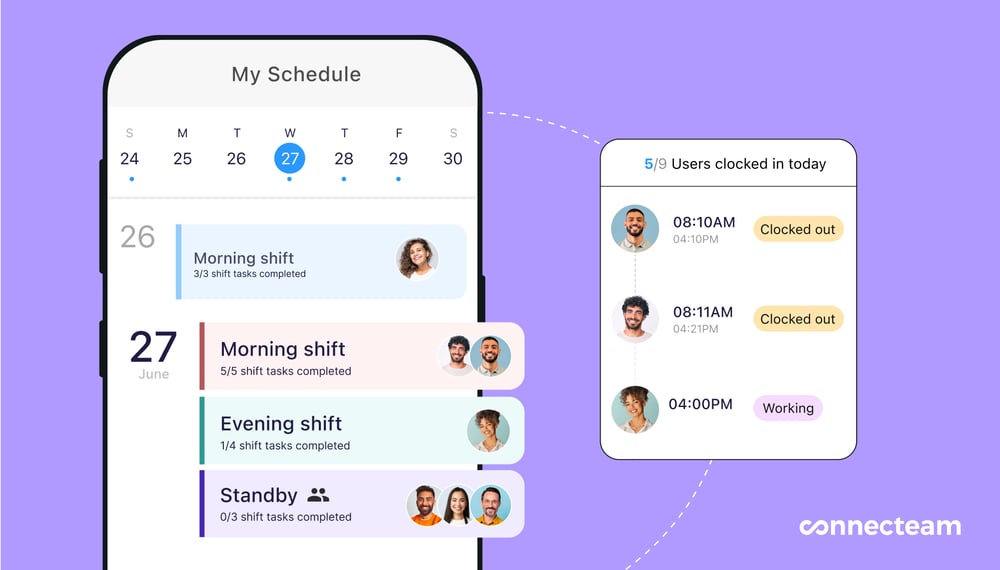
Before you take on more jobs, set up a few simple systems so work doesn’t fall through the cracks as you grow:
- Rostering: who’s doing what, where, and when (and how you’ll handle last-minute changes).
- Checklists and standards: what “done” looks like for each type of clean, plus photo or sign-off if needed.
- Timesheets and job records: start/finish times, notes, and incident reports in one place.
- Docs and training: safety info, chemical handling instructions, site notes, and onboarding.
You can run this with spreadsheets and messaging apps at first, but many cleaning businesses move to an all-in-one ops app as the team grows. For example, Connecteam can help you manage schedules, cleaning checklists, digital forms, staff documents, and in-app team communication in one place.
Purchase tools and supplies
The cleaning tools and supplies your business needs depend on the services you offer.
To get started, here are some common essentials for different types of cleaning:
- Residential cleaning: Household cleaning products, vacuum, mop and bucket, microfibre cloths, spray bottles, and rubber gloves. Estimated total cost: A$200–A$800.
- High-pressure cleaning: Cleaning products, high-pressure washers and nozzles, extension hoses, water tanks, non-slip boots, and goggles. Estimated total cost: A$400–A$5,000+.
- Builders’ cleaning: Industrial vacuum cleaner, paint scrapers, cleaning chemicals, skip bins, steel-capped boots, masks, and safety glasses. Estimated total cost: A$1,000 to A$10,000+.
Market your services
The best way to get clients for your cleaning business depends on the type of services you offer. Here are some ideas to get you started:
- Residential cleaning: Rely on word of mouth and referral programs, post in local Facebook or community groups, deliver flyers in your area, and advertise your services on online job platforms like Gumtree or Airtasker, where people often hire cleaners.
- Commercial cleaning: Cold-call or email local businesses, network on LinkedIn, partner with local real estate agents or property managers to refer customers, create a Google Business Profile so you appear in local searches, and consider targeted Google or Facebook ads.
- Builders’ cleaning: Advertise in online trade magazines, join local business or construction networking groups, build partnerships with construction firms, and approach site managers directly to offer your services.
No matter the size of your business, it’s also a good idea to register a domain name and create a simple website so potential clients can find and contact you easily. For design tips and inspiration, check out Connecteam’s guide on websites for cleaning businesses.
Additionally, you can join the National Australian Cleaners Association (NACLA) for professional support and to be listed in their directory of recommended cleaners.
How Much Does It Cost To Start a Cleaning Services Company in Australia?
The cost to set up a cleaning business varies widely depending on the company’s size, structure, and the services it provides.
For example, if you’re a sole trader offering home cleaning services, your costs for the first month might look like this:
- Business name registration: A$45
- Insurance: A$135 per month
- Tools and equipment: A$400
- Marketing: A$150
Estimated first-month total: A$730
If you’re starting a larger cleaning business with 5 or more employees, your first-month costs might be:
- Business name registration: A$104
- Insurance: A$1,200 per month
- Tools and equipment: A$9,000
- Marketing: A$2,000
Estimated first-month total: A$12,304
Pro Tip
You may be able to get financial help to start your business. Visit the Australian Government’s grants and programs finder to see what support is available.
Join Connecteam - The Best Cleaning App
Try for FreeFAQs
While you don’t need a general “cleaning licence” to be a cleaner, you may need to apply for specific licences based on the nature of the services you provide, such as high-rise window washing or builders’ cleaning. Check with your state or territory licensing authority to find out.
According to Payscale data, the average hourly pay for cleaners in Australia is A$25.51. Exact rates vary depending on their experience, niche, and location. Compensating your cleaning employees fairly is important. It encourages them to perform their work at a high standard and stay with your business for longer.
Cleaners are generally in demand in Australia, but the demand depends on the type of cleaning services they offer. For example, government data shows a current decrease in the need for residential cleaners, possibly due to the cost-of-living crisis and households reviewing their budgets.
Most cleaning businesses in Australia need public liability insurance. If you employ staff, you’ll usually need workers’ compensation (rules vary by state/territory). If you use registered vehicles, you need CTP plus other vehicle cover. Consider equipment cover too.
Choose your services and business structure, then apply for an ABN and register your business name if needed. Set up tax registrations (like GST if required), organise insurance, and check any required licences. Then buy equipment and start marketing.
It often costs about A$500 to A$15,000+ to start a cleaning business in Australia, depending on your services, equipment, insurance, and whether you hire staff. Solo home cleaning is usually cheaper; commercial or post-construction work often costs more.
A cleaning business in Australia can be profitable if you price jobs properly and control costs like labour, supplies, travel time, and insurance. Profit depends on your niche, local competition, repeat customers, and how efficiently you schedule work.
Disclaimer
The information in this guide is intended as an overview for general informational purposes only and does not constitute legal advice. While we have made every effort to ensure the information is up-to-date and reliable, we cannot guarantee its completeness, accuracy, or applicability to your specific situation. Employment laws change frequently, and outcomes may vary depending on your specific circumstances. For guidance, consult the relevant federal and local authorities, speak with an employment lawyer, and seek the advice of an accountant. Please note we cannot be held liable for any actions taken or not taken based on the information presented on this website.